Blinded By Sight At Teatro Nazionale Di Genova | In Conversation With Princess Isatu Hassan Bangura
With Blinded by Sight – The Body That Knows Before the Eyes, Princess Isatu Hassan Bangura returns to the myth of Oedipus to explore the relationship between sight, knowledge, and bodily memory. Following its presentation as a work-in-progress at the 2025 Venice Biennale, the solo performance premieres at Sala Mercato, Teatro Nazionale di Genova, from 13 to 18 October. In this conversation with GRIOT, the artist reflects on the power of myths and the limits of what we can know.

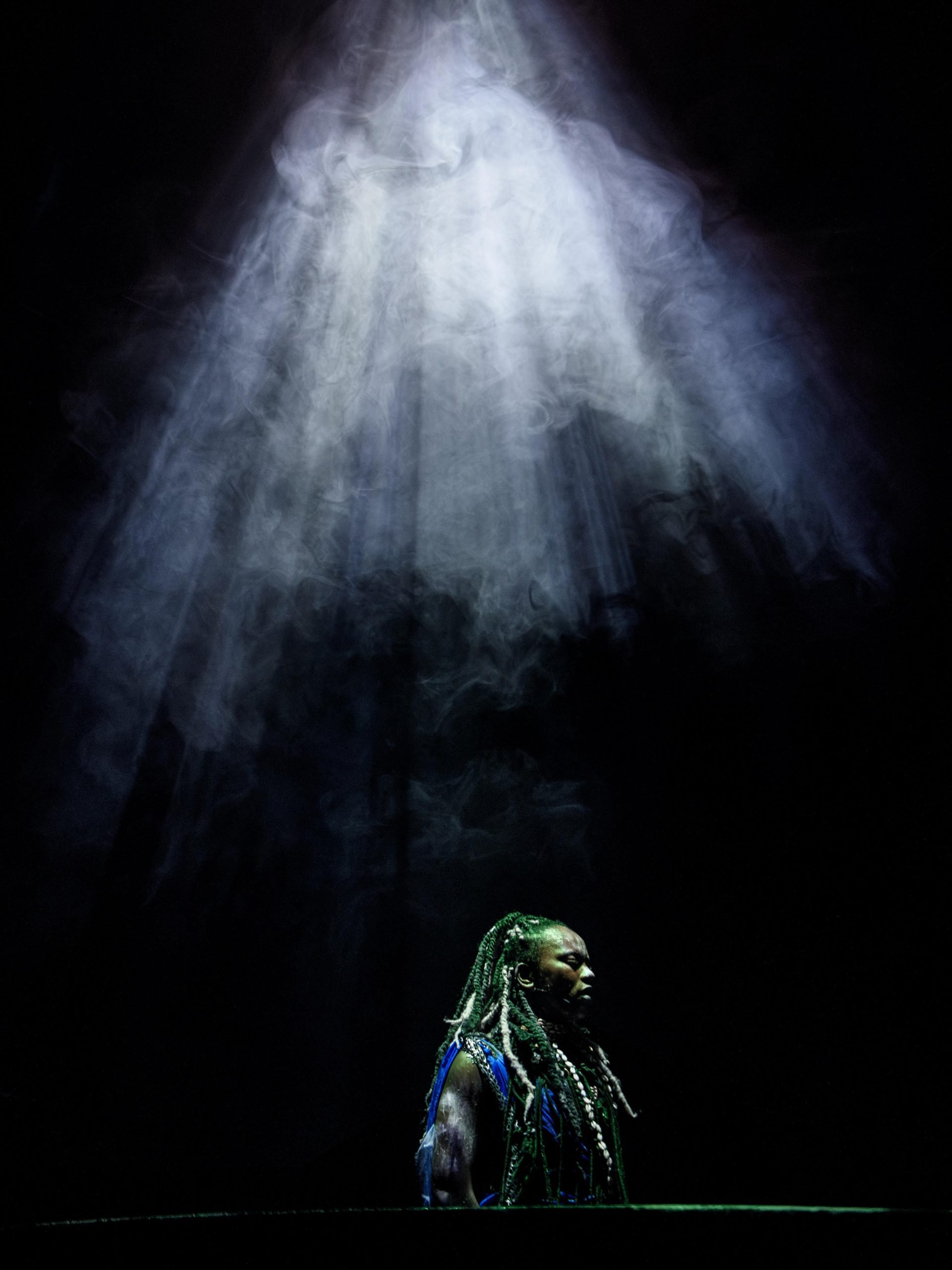
Oedipus seeks to know the truth, but what he discovers ultimately undermines the certainties on which he has built his identity. It is in this gap between seeing and understanding, between what we believe we know and what continues to elude us, that Blinded by Sight reopens the conversation with one of the most deeply rooted myths in the Western imagination. The story of Oedipus thus becomes a starting point for questioning not only the limits of perception, but also the categories through which we interpret the world and recognise others.
GRIOT: Let’s talk about the origins of your work. Oedipus is a figure through whom Western culture has built some of its deepest reflections on knowledge, truth, and the limits of perception. What happens when a story so deeply rooted in our collective imagination is read through the perspective that the canon has not historically treated as central? What draws you back to the myth?
PRINCESS ISATU HASSAN BANGURA: What draws me to Oedipus is not really the idea of retelling the myth. It is the condition he finds himself in: a person trying desperately to know himself, believing knowledge will give him control, and discovering instead that knowledge can completely undo the person he thought he was. There is something very contemporary in that for me. We inherit names, histories, families, places, expectations, systems…. we enter things long before we understand that we have entered them. And then at some point we begin asking: how much of this is actually mine? What did I choose? What was already moving before I arrived? I was also interested in what happens when I allow this canonical figure to pass through my own body rather than approaching him from a respectful distance. I am not trying to become Oedipus, and I don’t want Oedipus simply to become a metaphor for me. I am interested in the contamination between us, where his questions disturb mine and mine begin to disturb the myth. So I keep returning because the story refuses to stay ancient. It continues to ask very present questions about inheritance, identity, responsibility, belonging, and the terrible desire to know who we are.
 Princess Isatu Hassan Bangura, Blinded by Sight – The Body That Knows Before the Eyes – Ph. Federico Pitto. COURTESY Teatro Nazionale di Genova
Can we also read this tension as a critique of the claim to possess total knowledge of the other? If so, could you expand on this? Where do you place the boundary between wanting to know someone and needing to render them fully legible within your own categories?
There is a difference between wanting to encounter somebody and needing that person to become understandable according to categories I already possess. We do this very quickly. Someone gives us a gesture, a silence, a face, a history, and we begin completing the rest. That also connects to perception in the piece. We don’t simply receive reality; we interpret what reaches us. Memory, fear, expectation, experience….all of these participate in what we think we are seeing. The performance keeps returning to that gap between what arrives and what we construct from it. So for me there has to be an ethic of not knowing. If I cannot even make myself completely transparent to myself, how can I demand complete legibility from another person? I think intimacy has to contain some mystery. To love somebody is not necessarily to solve them.
In Blinded by Sight, the title immediately places sight and blindness in relation to each other. We are used to thinking of the gaze (and, in general, the act of seeing) as an instrument of knowledge, but we often forget that every gaze/look is situated: it sees from a specific place and through learned categories. How do you work with this tension in your practice? What can stay unseen precisely when we think we have seen enough?
Almost everything. The frightening thing about sight is how quickly it produces certainty. We look at somebody and believe we have received information, when actually we have also brought an enormous amount with us to that encounter … .our history, our language, our cultural assumptions, our fears. That is why I became interested in treating seeing as an active process rather than something neutral. In the work, the eye receives, but reception is not yet understood. Something still has to be interpreted. And I think we do the same thing socially. A body appears and immediately it can become gendered, racialised, nationalised, judged, desired, feared, categorised. Sometimes the moment we believe we have recognised somebody is precisely the moment we stop looking. My practice tries to interrupt that certainty. Darkness, distortion, sound, repetition and physical transformation can make the audience work differently. Perhaps if I take away some of the authority of the eye, another kind of attention becomes possible.
Oedipus’s blindness is often interpreted as a punishment he inflicts on himself, or as the price of a truth finally acknowledged. But what happens if we stop treating sight as the ultimate proof of knowledge? Are you interested in unsettling the assumption that to see is to understand, and that blindness is simply a lack of that? What could come out of dismantling the analogy?
Very much so, although I don’t want to romanticise literal blindness or suggest that blindness itself is some special route to wisdom. I am more interested in the cultural authority we give sight. We constantly use seeing as a synonym for knowing: now I see, I see what you mean, seeing is believing. We have built an enormous philosophical confidence around vision. Oedipus is fascinating because that relationship collapses. He can see and still fail to perceive what is directly around him. Later, when sight is gone, the question becomes less about looking and more about how else a body might attend to the world. That is where listening becomes very important for me. Maybe wisdom is not arriving at a place where everything is finally illuminated. Maybe it is developing the capacity to remain with uncertainty, to recognise that what I perceive is partial and that I can still be changed by what I do not understand. The work becomes less interested in replacing blindness with sight than in replacing certainty with attentiveness.
 Princess Isatu Hassan Bangura, Blinded by Sight – The Body That Knows Before the Eyes – Ph. Federico Pitto. COURTESY Teatro Nazionale di Genova
Memory is often told as something that belongs to the past, while the body carries it into the present through gestures and reactions – whose origin we do not necessarily know. In your work, is bodily memory primarily a form of witness, a wound that keeps speaking, or a way of passing on what would otherwise be lost?
I think it moves between all three. The starting point of the piece is very personal: the marks on my arm from burning myself with matches as a child and the memory of my grandfather stopping me. The physical mark survived, but its meaning didn’t remain fixed. Over time it became connected to him, to grief, to leaving, to love, to guilt, to memory. That interests me because the body does not archive the way a library archives. It does not preserve things neatly and objectively. It distorts, It repeats, It forgets, It reacts. Sometimes we carry something without having a language for its origin. A gesture, fear, rhythm, habit, way of loving, perhaps even something inherited from people whose stories we do not fully know. So I don’t necessarily trust bodily memory as factual evidence. But I take seriously the fact that the past continues to act through the present body. And sometimes what survives a person is very small: a smell, a laugh, a movement of the hand. That can become another form of inheritance.
Rewriting a myth does not necessarily mean freeing oneself from its legacy: sometimes it means confronting what continues to exercise power in the present. In working on Oedipus, which elements of the story did you feel the need to preserve, which to unsettle, and which, if any, to reject? What does it mean to engage with a tradition without having to accept all of its conditions?
I wanted to preserve the bones of the myth. The prophecy, the abandoned child, the crossroads, the riddle, the city in crisis, the mother and father, recognition, blindness, exile. I need those structures because they are what allow me to enter the story and then pull it apart. What I wanted to unsettle were the certainties around them. I am suspicious of a very clean opposition between fate and free will. Human beings make choices, but we don’t make them outside history, family, fear, biology, social structures or the decisions other people have already made for us. That doesn’t remove responsibility, but it complicates it. I also wanted to unsettle the heroic centre of the story. Oedipus does not remain the single sovereign body around which everything revolves. Other bodies begin to enter: mother, child, ancestor, grandfather, my own body. And I reject the requirement that suffering must eventually become redemption. Colonus became important because Oedipus is not magically purified. What moves me is that a body that has been rejected and treated as dangerous is finally received. That is enough for me. I don’t need innocence restored.
Some stories are handed down as universal, while others remain at the margins, considered particular, peripheral, or absent. This hierarchy also shapes how the knowledge and memories of bodies are recognized. Do you think theatre can intervene in this distribution of cultural authority? And what can performance do that a text or a conventional staging cannot do in quite the same way?
I think it can, particularly because theatre involves an actual body occupying space. There is a difference between discussing who has been excluded from a canon and allowing a body that was not historically imagined as its centre to enter that material and transform its terms. But I don’t think the solution is simply representation, put a different body into an old structure and declare the problem solved. I am interested in whether the structure itself begins to change. Who is allowed to be universal? Who is required to explain themselves? Why does one story become mythology or philosophy while another remains autobiography, testimony or identity? Performance allows those categories to become unstable. Onstage I don’t have to remain only Princess, or only Oedipus, or only narrator. The voice can move. Gender can move. Time can move. The dead can enter the living. One body can temporarily carry several bodies without resolving them into one identity. And unlike a text, performance also makes the audience physically present inside that exchange. They breathe in the room. They witness. Eventually they can become part of the rhythm themselves. That possibility of turning spectatorship into witnessed participation is very important to me.
 Princess Isatu Hassan Bangura, Blinded by Sight – The Body That Knows Before the Eyes – Ph. Federico Pitto. COURTESY Teatro Nazionale di Genova
In Blinded by Sight, the relationship between Oedipus and the truth opens a reflection on what it means to know, and on how far this search can involve the body as well as the mind. What led you to explore truth through a physical and poetic dimension? And what does ritual make possible when we approach something that can’t always be explained or put into words?
Because some things I know did not arrive through thought. They arrived as a sensation. A tightening, an impulse, a hesitation, fear, heat, the desire to run, the desire to return. Sometimes the body has already reacted before the mind has produced a story about why. That became one of the central questions of the work: what happens in that interval between bodily response and conscious explanation? The three chapters increasingly move from perception, through decision, toward a state where certainty itself has to be surrendered. Poetry lets me remain inside that interval without immediately closing it. And ritual does something similar. Repetition can change the meaning of a word. Breath can become rhythm. Rhythm can become trance. Language can eventually stop behaving like language and become sound. That is important because there are experiences; grief especially, that become smaller when we explain them too quickly. Ritual allows me to stay with the thing before naming it. And sometimes, when language reaches the point where it cannot carry any more, the voice can still continue. The body can still continue. That is where the work lives for me.
Princess Isatu Bangura (Sierra Leone) is a multidisciplinary performance artist, playwright, director, and storyteller. Her work weaves together memory, movement, ritual, song, and ancestral knowledge to create theatrical experiences deeply rooted in the body. She trained at Toneelacademie Maastricht in the Netherlands, where she moved with her family at the age of thirteen, fleeing the civil war in her home country. This experience has profoundly shaped her artistic practice, which brings spiritual inquiry into dialogue with decolonial thought to explore identity, belonging, and the body as a site of conflict, transformation, and liberation. Drawing on African and European artistic traditions, she has developed a distinctive aesthetic language in which personal history becomes collective ritual and the stage serves as a space for reckoning, reconciliation, and imagining the future. In Italy, she first gained recognition for her performance in Milo Rau’s Grief & Beauty, produced by NTGent. The company also produced her debut work, Great Apes of the West Coast, which she wrote, directed, and performed. In 2024, the piece earned her the Theo d’Or, the Netherlands’ most prestigious theatre award. It has been presented in Italy at Romaeuropa in October 2023, at the 2025 Venice Theatre Biennale, directed by Willem Dafoe, and at various European theatres and festivals, including the Théâtre National de Strasbourg, Next Festival in France, LikeMinds in Amsterdam, Rotterdamse Schouwburg, and Toneelhuis in Belgium. In 2025, she created Blinded by Sight, a physical and lyrical solo performance exploring the downfall of King Oedipus, first presented as a work-in-progress at the 2024 Venice Theatre Biennale. In January 2026, she was appointed Junior Artistic Director of Teatro Nazionale di Genova, working in close creative dialogue with Davide Livermore, who was appointed sole director. She is currently touring internationally with Wild Woman.
Princess Isatu Hassan Bangura
Blinded by Sight – The Body That Knows Before the Eyes
Dates: 13–18 October 2026
Performance times:
13, 14 and 16 October at 8:30 pm
15 and 17 October at 7:30 pm
18 October at 4:00 pm
Venue: Sala Mercato – Teatro Nazionale di Genova
– by Michela Palermo
This post is also available in:

GRIOT
Sharing. Inspiring. Spreading culture. GRIOT is a nomadic space, a botique media platform, and a collective collecting, amplifying and producing Contemporary Culture, Arts, Music, Style, from Africa, its diaspora and beyond.